From Cavalry to Community: How Nigerian Women are Revitalizing Queen Amina’s Legacy to Defeat Modern Insecurity
Historically, Nigerian women have always been at the vanguard of peace, security, and resistance. From the legendary military campaigns of the 16th century to modern-day grassroots and structural interventions, women have consistently stepped into the gap to protect their communities during times of crisis.
The Ultimate Benchmark: Queen Amina of Zaria
To understand the prowess of modern Nigerian women fighting insecurity, one must look back to Queen Amina of Zazzau (Zaria). Ruling in the late 16th century, Amina was a master military strategist who expanded her kingdom’s borders through sheer martial brilliance, commissioning the construction of formidable earthen fortifications—the famous Zaria walls—that redefined regional security.
When Amina passed, she left a legendary vacuum. For centuries, traditional warfare was viewed through a heavily patriarchal lens, and few individual rulers—male or female—could match her unique combination of territorial defense, tactical expansion, and absolute command.
However, modern Nigerian women are not trying to replicate Amina’s exact model of imperial conquest. Instead, they are filling that historical vacuum by evolving the definition of security itself. Where Amina fought with cavalry and armor, today’s women fight with intelligence, community organizing, policy advocacy, and strategic peacebuilding.
Modern Success Stories: Fighting Insecurity on All Fronts
Today, Nigerian women are responding to complex, asymmetrical security threats—such as insurgency, banditry, and communal clashes—by occupying critical spaces in the nation’s security architecture.
Grassroots Peacebuilding and Early Warning Systems
In the North-East and North-Central regions, women have become the backbone of community-based security. Through organizations like the West Africa Network for Peacebuilding (WANEP-Nigeria), women are actively leveraged in Early Warning Systems. Because women are deeply embedded in the social fabric of local communities, they are often the first to notice unusual movements, radicalization trends, or shifting dynamics, allowing them to report and prevent violence before it escalates. Furthermore, as mothers and pillars of the community, women’s groups have successfully negotiated the release of captives, mediated localized pastoralist-farmer disputes, and established demilitarized zones for trade and education.
Institutional Leadership and the WPS Agenda
Nigeria’s security framework has been significantly shaped by women pushing for the institutionalization of the United Nations Security Council Resolution 1325 (UNSCR 1325) on Women, Peace, and Security (WPS). Female policymakers, academics, and activists have successfully driven the domestication of State Action Plans across various regions. They have fundamentally changed the narrative, proving that sustainable security is not just about kinetic military force, but also about human security, protection from gender-based violence, and socio-economic stability.
Frontline Counter-Terrorism and Civil Defense
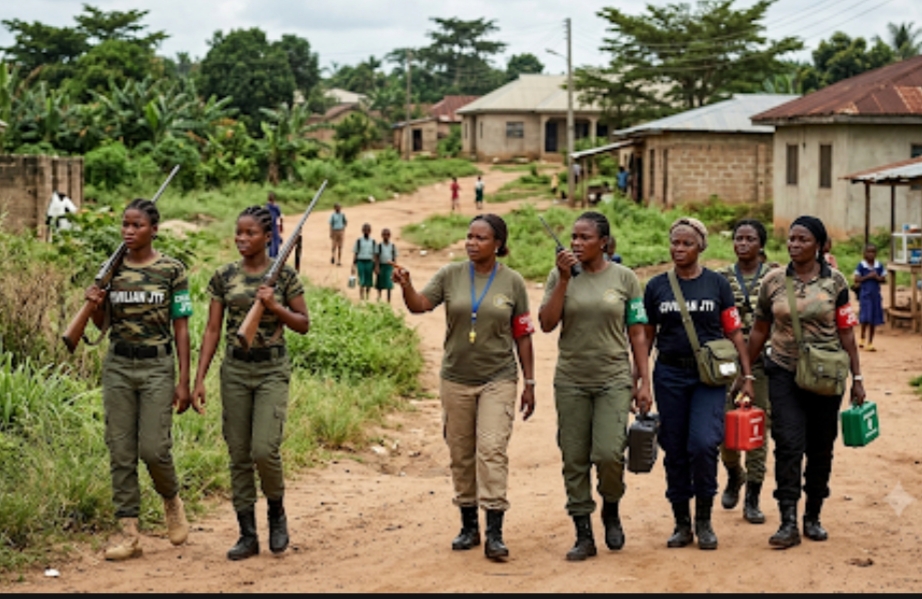
Beyond policy, women are physically on the frontlines. In the fight against Boko Haram in the North-East, hundreds of women joined the Civilian Joint Task Force (CJTF). They perform high-risk tasks, including intelligence gathering, entering spaces male operatives cannot access due to cultural sensitivities, and conducting vital security screenings at displaced persons camps and market entry points. Simultaneously, an increasing number of women are rising through the ranks of the Nigerian Armed Forces, Police Force, and Civil Defense, leading specialized tactical units and counter-insurgency operations.
Reimagining the Vacuum: Then vs. Now
The prowess of Queen Amina lay in state-centric, territorial expansion and physical fortification. Her strategy relied on direct military command and building defensive walls, leaving a void in singular, centralized monarchical power when she died.
In contrast, modern Nigerian women address human security, conflict de-escalation, and intelligence tracking through grassroots mediation and global policy frameworks. They have effectively replaced the singular vacuum left by Amina with a decentralized, resilient collective network of peacebuilders.
The Takeaway:
While Queen Amina’s death left a vacuum that no single military ruler could easily duplicate, modern Nigerian women have collectively risen to fill that void. They have proven that fighting insecurity requires more than just holding a shield; it requires building sustainable bridges of peace, transforming local intelligence into national strategy, and standing firmly as the frontline defenders of their communities.