Whistles, Walls, and World Stages: The Unstoppable Rise of Nigeria’s Female Referees
By Isaac Eranga
For decades, when football fans thought of Nigerian dominance on the green grass, the mind instantly flashed to the Super Falcons—Africa’s most decorated women’s national team. But away from the goal-scoring exploits of star forwards, a quieter, equally fierce revolution has been brewing.
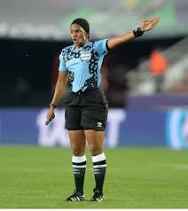
Today, Nigerian women are no longer just commanding the ball; they are commanding the whistle. From the local pitches of the Nigeria Women Football League (NWFL) to the grand, pressure-cooked arenas of continental showpieces, Nigeria’s female football referees have steadily scaled the ranks, stepping out from the shadows and into the international limelight.
Breaking the Grass Ceiling
Historically, officiating in Nigeria was an old boys’ club. The domestic leagues—especially the Men’s Nigeria Professional Football League (NPFL)—were notorious for hostile environments, making the pitch a daunting place for any official, let alone a woman.
Yet, pioneers like Folusho Ajayi paved the way by fearlessly holding their own in highly volatile men’s top-flight matches. Ajayi and her contemporaries proved that composure, technical understanding, and physical fitness have no gender. Their resilience shifted the narrative, convincing the Nigeria Referees Association (NRA) and the NFF to actively invest in and badge female officials.
The Path to the Continental Stage
The international breakthrough for Nigeria’s female officials has been built on a foundation of rigorous training, mandatory FIFA fitness tests, and elite technical clinics.
In recent years, names like Mimisen Iyorhe have broken monumental ground. Iyorhe, a highly respected assistant referee, smashed boundaries by earning selections to major tournaments, including the FIFA U-20 Women’s World Cup in Costa Rica. Her precision on the sidelines showed the world that Nigerian officials possessed the elite standard required by global governing bodies.
The momentum has only intensified, highlighted by key career breakthroughs:
- Mimisen Iyorhe: Achieved a historic selection to the FIFA U-20 Women’s World Cup panel, proving the elite standard of Nigerian assistant refereeing on the global stage.
- Yemisi Akintoye: Rapidly rose through the domestic ranks to command matches at the CAF Women’s Champions League and earn a prestigious spot at the Women’s Africa Cup of Nations (WAFCON).
Referees like Akintoye have become the face of this new vanguard. After proving her mettle at the domestic level and during the CAF Women’s Champions League, Akintoye earned a prestigious spot among the elite match officials selected for the Women’s Africa Cup of Nations (WAFCON). To be selected among Africa’s finest from a pool of hundreds is a massive stamp of authority on the quality of Nigerian female officiating.
Overcoming the “Quality First” Hurdle
The rise of these women is even more remarkable considering the historic hurdles Nigerian officiating has faced. In the past, world-stage selections from Africa often bypassed Nigeria due to structural deficiencies in domestic league broadcasts and a lack of early exposure to Video Assistant Referee (VAR) technology.
When FIFA Referees Committee Chairman Pierluigi Collina famously emphasized a strict “quality first” metric for World Cup selection, it served as a wake-up call. Nigeria’s female officials took the challenge head-on. By excelling in CAF’s grueling medical, physical, and technical assessments, officials like Akintoye, Hannah Elaigwe, and Olufunmilayo Alaba have steadily restored Nigeria’s refereeing prestige on the global stage.
The Ultimate Impact: Inspiring a New Generation
The visibility of these women on international television feeds has a profound trickling effect. Every time a Nigerian woman steps onto the pitch in a CAF or FIFA kit, she rewrites the possibilities for thousands of young girls back home.
”Officiating is no longer just a weekend hobby or a footnote in Nigerian sports; it is a viable, prestigious career path to global prominence.”
With a growing crop of young, FIFA-badged talent—including newly listed officials like Tomilayo Omotoye and Faith Agbons—the conveyor belt of Nigerian refereeing talent is busier than ever. They are proving that with integrity, peak physical conditioning, and an unflinching command of the laws of the game, the walk from a local pitch in Lagos or Abuja to the grandest stadiums in the world is entirely possible.