
Markets Are Not Enough: Edo Women Urge Governor Okpebholo and Mrs. Anani to Sign the Women, Peace, and Security Agenda
By Isaac Eranga
When the Edo State government erects modern market structures, the gesture is often celebrated with fanfare. New stalls, proper drainage, and secure perimeters are undoubtedly important for economic activity. But walk through those vibrant corridors, past the neatly arranged displays of food and goods, and a deeper conversation unfolds among the market women, community leaders, and local activists.
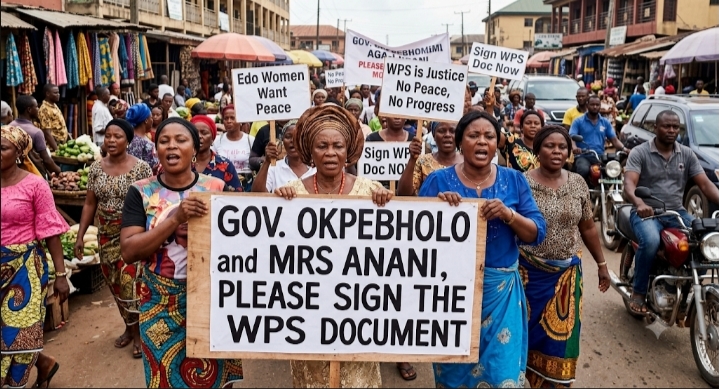
For the women of Edo State, physical security and commercial spaces are only a fraction of what is required to build a resilient society. The message emerging from grassroots communities to the Governor of Edo State and the Coordinator of the Office of the First Lady, Mrs. Anani Okpebholo, is unequivocal: Building markets is a welcome development, but it is not enough. Edo women are demanding an active voice in governance and security through the immediate adoption and implementation of the State Action Plan on Women, Peace, and Security (WPS).
The Unspoken Cost of Exclusion
Women are consistently on the frontlines of community life. They are the first to sense rising local tensions, the primary caregivers when violence disrupts livelihoods, and the vital ties holding families together during crisis. Yet, when discussions surrounding security, conflict resolution, and peacebuilding take place, women are all too often relegated to the background—treated merely as beneficiaries or victims rather than strategic partners.
While economic empowerment through market infrastructure helps sustain families, it does not address the underlying security vulnerabilities that women face daily. Economic stability cannot thrive in an environment where peace decisions are made without the input of half the population.
The Paradox of Inclusion
- Traditional Focus:
- Prioritizes physical and economic infrastructure, such as building market stalls.
- Treats women primarily as passive recipients of aid or facility users.
- Focuses intervention mostly on post-conflict relief support after crises occur.
- What Edo Women Demand:
- Guaranteed seats and active representation on local and state security boards.
- Recognition of women as strategic decision-makers in peacebuilding and mediation.
- The institutionalization of a fully funded Women, Peace, and Security framework.
Why the WPS Agenda Matters for Edo State
The United Nations Security Council Resolution 1325 on Women, Peace, and Security emphasizes four fundamental pillars: Prevention, Protection, Participation, and Relief & Recovery. For Edo State, localizing this agenda is not just a policy formality; it is a transformative governance tool.
- Strategic Conflict Prevention: Women possess unique community intelligence and early warning insights. Integrating them into security councils allows government bodies to nip emerging conflicts in the bud.
- Inclusive Security Governance: Peace agreements and security strategies last longer and prove more effective when women participate in designing and executing them.
- Targeted Protection Measures: Security interventions designed with women’s input directly address systemic issues like gender-based violence, safety in public spaces, and farm-level protection.
A Direct Call to Leadership
The path forward requires visionary leadership that looks beyond physical infrastructure to build lasting human governance structures.
- To the Governor of Edo State: The administration has a unique opportunity to leave an indelible legacy by prioritizing the formal signing and full funding of the Edo State Action Plan on Women, Peace, and Security. Empowering women with political will and legislative backing transforms security management from a reactive measure into a sustainable, community-driven framework.
- To Mrs. Anani Okpebholo (Coordinator, Office of the First Lady): As a crucial bridge between the grassroots and the highest levels of state decision-making, the Office of the First Lady holds significant influence to champion this cause. By amplifying the voices of Edo women and pushing for the signing of the WPS Action Plan, Mrs. Okpebholo can ensure that the women who drive the state’s informal economy are also given the platform to safeguard its peace.
Conclusion: From Trade to Decision-Making
Building markets gives women a place to trade, but signing and enacting the Women, Peace, and Security framework gives them a platform to lead. True stability in Edo State will be achieved not when women are merely kept safe inside market stalls, but when their insight, experience, and leadership shape the policies that govern the state’s security and future.