
Safeguarding the Green Horizon: SCERA and the National Park Service, Convenes Stakeholders in Udo to Deploy Forest Restoration Strategy for Okomu Landscape
By Isaac Eranga
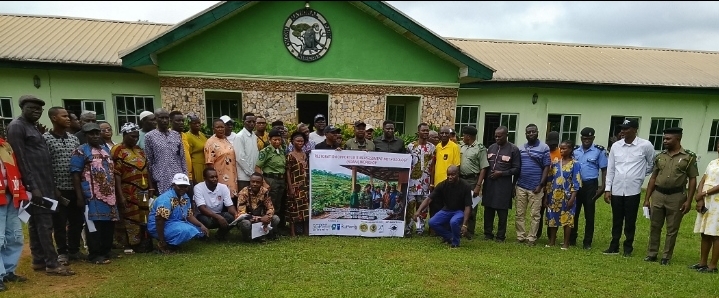
UDO, EDO STATE — As the global climate crisis intensifies, stakeholders and conservationists in Edo State have taken a decisive step toward reclaiming the state’s vanishing green canopies. Under the auspices of the Society for Sustainability and Conservation Education for Rural Areas (SCERA), in collaboration with the National Park Service and with financial support from the United Nations Development Programme Global Environment Facility Small Grants Programme (UNDP-GEF SGP) and The Rufford Foundation, a pivotal workshop introducing the Restoration Opportunities Assessment Methodology (ROAM) for the restoration of the Okomu Landscape, was hosted at the headquarters of the Okomu National Park in the historic Udo community.
The diagnostic gathering brought together communities and resource users in the Okomu Landscape, conservation officers, government representatives, and private sector giants to tackle the severe degradation threatening the Okomu ecological landscape.
The Last Bastion: Okomu National Park Under Threat
Addressing the workshop, the Deputy Conservator of Park (DCP), Matthias Enaberue, painted a sobering picture of the state of forestry in Nigeria.
“Forests are facing severe challenges worldwide,” Enaberue warned. “In Nigeria, people are not taking forest conservation seriously because of a relentless drive for money.”
He revealed a startling historical decline: Edo State once boasted 47 flourishing forest reserves, but today, the only preserved and conserved forest remaining is the Okomu National Park (ONP).
The Threats:
The Okomu landscape is increasingly fractured by rapid deforestation, agricultural expansion, aggressive illegal logging, unsustainable resource use, bush burning, and a weak regulatory environment.
The Mission:
DCP Enaberue emphasized that the workshop was a critical intervention “to learn how to restore what we have depleted.”
A Call for Local “Gatekeepers” & Global Benchmarks
In his address, the Conservator of Park (CP), Lawrence Osazee, called on SCERA to establish dedicated local “gatekeepers” across all buffer-zone communities to actively protect the boundaries of the forest.
Taking a leaf from global standards, Osazee urged Nigerians to emulate cities like London, where urban forestry is heavily integrated into development. He noted that former President Goodluck Jonathan attempted a similar greening framework in the Federal Capital Territory, Abuja.
Osazee urged participants to approach tree planting not as a chore, but as a passion requiring concerted national effort. To inspire the attendees, he cited the remarkable feat of an individual in Osun State who successfully established a thriving artificial forest through sheer determination.
Deciphering ROAM: The Restoration Roadmap
Joseph Molokwu, the Technical Program Officer for SCERA, explained that the workshop’s primary focus was to dissect and deploy ROAM (Restoration Opportunities Assessment Methodology) to provide information needed for systematically reversing land degradation.
According to Molokwu, while coordination remains the ultimate key to success, ROAM is designed to answer five fundamental questions:
Where to carry out the landscape restoration? – Mapping out targeted degraded landscapes.
What are the most appropriate restoration options for the landscapes? – Identifying the best ecological restoration strategies per zone.
What are the costs and benefits of different restoration strategies? – Evaluating the financial and ecological metrics of various models.
Who are the key stakeholders? – Mapping out key players, land users, and land owners.
What policy is on ground to support the restoration? – Assessing the legislative and political backing on the ground.
The Five-Step Hands-On Approach
Fleshing out the practical execution of maps produced, a GIS Specialist, Dr. Shomboro Karau, introduced a simple, community-friendly five-step guide to selecting and executing a restoration project:
Walk the land (Physical assessment)
Mark the spot (Defining restoration boundaries)
Match a method (Choosing trees/crops suited for the soil)
Agree on a plan (Achieving community consensus)
Care and Watch (Post-planting maintenance and monitoring)
Community Voices: Livelihoods vs. Conservation
Representing the host community, Chief Erhabor John of Udo called for unified, concerted efforts from all indigenes, noting that restoring the forests in Edo state is ultimately “for the collective good of the Edo people.”
However, highlighting the delicate balance between environmental conservation and economic survival, Chief French Yabike of the Okomu community championed the integration of agroforestry.
“Most farmers rely on farming as their sole means of livelihood,” Chief Yabike pointed out. He emphasized that while on-the-spot assessments are crucial, some zones must allow farmers to intercrop trees with food crops, though selected areas should be strictly reserved for wild tree planting.
Government and Private Sector Pledge Massive Backing
The workshop also highlighted ambitious institutional commitments aimed at driving long-term restoration:
1. Edo State Forestry Commission (2023–2032 Strategy)
Representing the commission, Mr. Ajayi Solomon outlined the Edo State Forest Restoration and Plantation Strategy, designed to correct past policy failures and chart a new environmental course.
The Goal: Cultivate a massive forest footprint of 40,000 hectares by 2032.
Current Progress: The state government has already planted 120,000 trees across Ehor, Iguobazuwa, Ubiaja, and Okhuesan.
Farmer Incentives: To encourage local cooperation, the state is offering free seedlings, land allocation, extension services, and utilizing the Modified Taungya System (allowing farmers to cultivate crops alongside young forest plantations).
2. Okomu Oil Palm Company PLC
Recognizing the role of corporate responsibility, Ayo Isaac, representing Okomu Oil, announced that the agribusiness giant has earmarked 3,000 hectares of land specifically for forest regeneration. This allocation aims to ensure that commercial farming and biodiversity can sustainably coexist in the region.
The Takeaway:
The ROAM workshop in Udo marks a critical milestone where community stewardship, corporate responsibility, and policy enforcement converge. If the passion called for by the Conservator of Park translates into action, the Okomu landscape may yet restore its lost glory.