
How Edo State Criminalizes Dehumanizing ‘Corpse Water’ Ritual for Widows
By Isaac Eranga
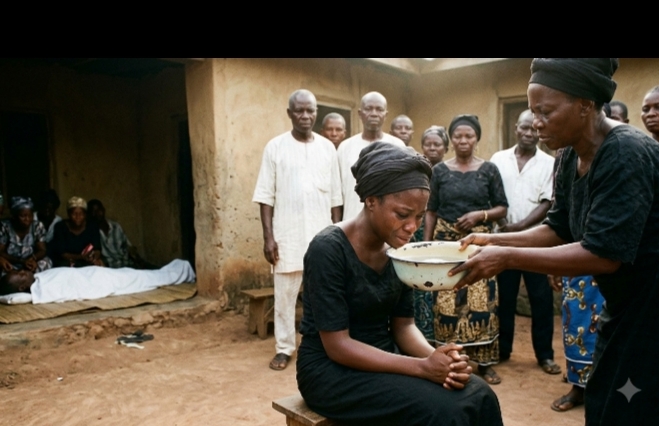
BENIN CITY, Nigeria — For generations, the shadow of a husband’s demise brought a secondary, deeply intimate terror for many women in Edo State: the ritual of trial by ordeal. Among the most harrowing of these traditional mourning practices was forcing a newly bereaved widow to drink the water used to wash her late husband’s corpse.
The custom was rooted in a grim superstition—that if the widow were responsible for her husband’s death, the water would poison or expose her. If she vomited or refused, her guilt was sealed in the eyes of the community, often leading to banishment, physical abuse, or total asset forfeiture.
Now, a decisive legislative hammer has fallen. The Edo State Government has officially prohibited forcing widows to undergo this and other dehumanizing burial rites, signaling a major victory for human rights and gender equality in the region.
Breaking a Cycle of Trauma
To understand the weight of this legal shift, one must look at the invisible scars carried by survivors. For many women, the loss of a spouse was immediately followed by a trial where they were treated as the primary suspects.
”You are grieving the love of your life, and within hours, your in-laws are accusing you of murder,” says an advocate from the International Federation of Women Lawyers (FIDA), who has handled numerous widow abuse cases in the state. “Being forced to swallow that water is not just a health hazard; it is a profound psychological violation designed to strip a woman of her dignity when she is at her most vulnerable.”
Medical professionals have long warned against the practice, citing severe risks of bacterial infections, cholera, and toxic shock from consuming water exposed to decomposing tissue. Yet, because the ritual was deeply woven into the fabric of local customary laws, many women complied out of fear. Refusal meant losing custody of children and being driven into absolute poverty.
What the Law Says: Key Sections and Penalties
This protective shield is heavily reinforced by state and national legislation. Crucially, under Section 15(1) of the Violence Against Persons (Prohibition) Law (VAPP)—which has been domesticated and rigorously strengthened in Edo State—harmful traditional and widowhood practices are treated as serious criminal offenses:
- Section 15(1) [The Offense]: This section explicitly states that any person who subjects a widow to harmful traditional practices commits an offense. The forcing of a widow to drink corpse-washing water falls squarely under this definition of “repressive and degrading” customary practices.
- Section 15(1) [The Punishment]: Perpetrators—often aggressive in-laws or community elders—who violate this provision are liable upon conviction to a term of imprisonment of up to two years, a hefty fine of up to ₦500,000, or both.
- Section 9 [Forceful Eviction]: To prevent the economic destitution that usually accompanies these rituals, Section 9 of the VAPP Act additionally criminalizes the forceful eviction of a spouse from their matrimonial home, carrying a penalty of up to two years imprisonment or a ₦300,000 fine.
These provisions build upon earlier foundations, such as the Edo State Inhuman Treatment of Widows (Prohibition) Law, solidifying a comprehensive legal network to protect grieving women.
The Battle for Enforcement in Rural Spaces
While human rights activists are celebrating the legislative milestone, they acknowledge that the real battlefield lies in enforcement, particularly within rural communities outside the capital of Benin City.
In distant villages, traditional rulers and family elders often hold more immediate authority than state lawyers. Activists point out that laws alone cannot fully protect a widow if she is too afraid of social ostracization to report her own in-laws to the police.
- Deep-Rooted Superstition: Requires aggressive grassroots sensitization campaigns specifically involving local monarchs, customary courts, and religious leaders to change mindsets.
- Fear of Reporting: Solved by establishing anonymous hotlines, community surveillance, and state-backed legal aid for vulnerable widows.
- Economic Vulnerability: Addressed by strictly enforcing the widow’s legal right to inherit her husband’s property and protecting her from being forcefully ejected from her home.
A New Dawn for Edo’s Women
The prohibition marks a historic turning point. It shifts the burden of proof away from the grieving wife and firmly places the accountability onto those who seek to abuse her.
- As Edo State moves forward with public awareness campaigns, the message from the government is unambiguous: the ancient, agonizing trials of widowhood are officially a thing of the past. For the women of Edo, the law finally offers a promise that their grief will no longer be met with cruelty.